Table of Contents
A Protestant Trip to Paris in 2026: Churches, Worship, and Reformed History
Key takeaway: Paris is home to about ten active Reformed and Lutheran churches, including several architectural gems. The Oratoire du Louvre, the Temple de l’Étoile, Pentemont, and the Foyer de l’Âme form the foundation of a successful Protestant visit, featuring Sunday services, Cavaillé-Coll organs, and Huguenot heritage. Plan on three to four days to explore the major sites and the capital’s Reformed history, aiming for Sunday mornings for the 10:30 a.m. service and Saturday afternoons for concerts.
Paris does not immediately come to mind as a center of Protestantism. The capital remains associated with its cathedrals, its abbeys, and its Catholic buildings that define the skyline of its bridges. Yet the city is home to a Reformed tradition dating back four centuries, marked by the Edict of Nantes, shattered by its revocation in 1685, revived by Napoleon in 1802, and whose churches tell a story of patience and a return to the light.
This guide offers an itinerary for experiencing Paris as a Protestant, from Sunday worship at the Oratoire du Louvre to the organs at the Temple de l’Étoile, via the Huguenot heritage of the Marais and the Bersier Foundation. Here you’ll find the most important places of worship, service schedules, concerts you won’t want to miss, and neighborhoods where you can stay just minutes away from the major sites of the French Reformation.
Table of Contents
- Paris and Protestantism: A History of Resilience
- The Great Temples of Paris: Oratoire, Étoile, Pentemont, Foyer de l'Âme
- Church Services and Concerts: Schedules, Choirs, Organs
- Desert Museum, Bersier Foundation, and Reformed Heritage
- Historical Tour: The Huguenot Quarter and the Reformed Marais
- The Merveil Experience: Residences Near Places of Worship
Paris and Protestantism: A History of Resilience
From the Edict of Nantes to the Revocation
The Protestant history of Paris began in tragedy. The St. Bartholomew’s Day Massacre, in August 1572, decimated the Huguenot community in the capital and cemented the city’s connection to the Reformation. Twenty-six years later, on April 30, 1598, Henry IV issued the Edict of Nantes, which granted Protestants freedom of conscience and worship. Paris then had several thousand believers, a church in Charenton, and a genuine place in the life of the court.
Everything changed on October 18, 1685. Louis XIV signed the Edict of Fontainebleau, which revoked the Edict of Nantes. Churches were destroyed, pastors exiled, and the faithful forcibly converted. Between 150 000 and 180,000 Protestants left France over the course of thirty years, heading for Geneva, the United Provinces, England, and Prussia. Paris lost its visible community. Worship went underground, entering this clandestine period that would last a century.
The Return and the Napoleonic Assignment
Recognition returned under Napoleon. The Organic Articles of 1802 reestablished the Reformed and Lutheran faiths. On February 4, 1811, the emperor designated the former Oratorian church on Rue Saint-Honoré for Protestant worship, a symbolic gesture that gave the Parisian Reformation its grand central sanctuary. Pentemont was granted that same year, then returned to religious use in 1846 after a long period of military occupation. Throughout the 19th century, the community reorganized, built its churches, and reinvented its presence in the capital.
The Great Temples of Paris: Oratoire, Étoile, Pentemont, Foyer de l'Âme
The Oratoire du Louvre, the liberal heart of the Parisian Reformation
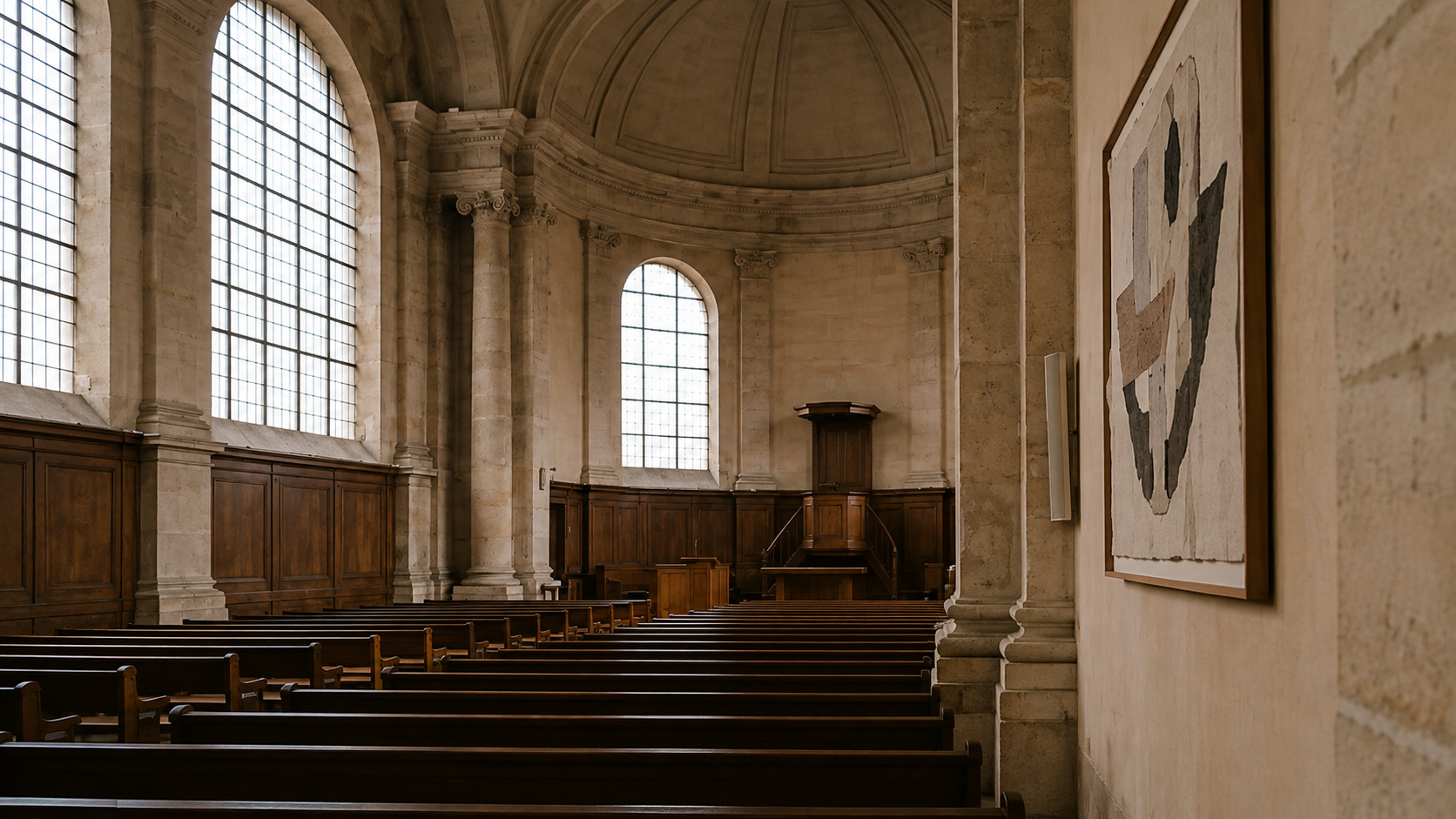
Located at 145 Rue Saint-Honoré, across from the Louvre colonnade, the Oratoire is the flagship of Parisian Protestantism. Construction of the building began in 1621; it served as a royal chapel before being handed over to the Reformed Church by Napoleon. The bright, high-ceilinged nave, unadorned in the Protestant style, lets in harsh light that accentuates the simplicity of the space. The grand Cavaillé-Coll organ from 1893 provides the musical backdrop for services and concerts.
The Oratory upholds the liberal tradition of French Protestantism, characterized by a historical-critical reading of the Bible and an open dialogue with contemporary culture. The Sunday service at 10:30 a.m. brings together a faithful congregation and visitors who come to experience this approach. Admission is open to all, free of charge, and no registration is required; the building opens one hour before the service for those who wish to admire the architecture before the sermon.
The Temple of the Star: Neo-Gothic and Musical
Located at 54 Avenue de la Grande-Armée in the 17th arrondissement, the Temple de l'Étoile departs from the classic Reformed style. The building, inaugurated in 1874, was commissioned by Pastor Eugène Bersier, a Huguenot of Swiss origin. Swedish architect William Hansen designed it in a Neo-Gothic style reminiscent of high-chapel Anglican churches, featuring vaults, stained-glass windows, and a pronounced apse. This uniqueness stems from Bersier’s desire to give the Reformation a dignified and solemn aesthetic.
The church celebrated its 150th anniversary in 2024 and remains one of the most vibrant centers of Protestantism in Paris. Services are held every Sunday at 10:30 a.m., and organ and choir concerts take place throughout the year; the parish’s influence extends well beyond its own district. Louis Pernot, who has been the pastor since 1991, preaches there regularly.
Pentemont, the temple of the Left Bank
At 106 Rue de Grenelle, in the 7th arrondissement, the Pentemont Temple occupies the chapel of a former Bernardine abbey. The building, consecrated in 1756 to Saint Clotilde, was granted to the Reformed Church in 1802. It served as a military barracks until 1843, before being restored by Victor Baltard, the architect of the Central Market Halls. The Protestant dedication ceremony took place on November 8, 1846, in the presence of Minister François Guizot, a leading figure in political Protestantism during the July Monarchy.
The Cavaillé-Coll organ, installed in 1847, is still in place and is played at every service. Since 2005, the parish, together with the Luxembourg church, has formed the United Protestant Church of Pentemont-Luxembourg, a Lutheran and Reformed communion that embodies the union of these two great traditions.
Le Foyer de l'Âme: Social Protestantism Near the Bastille
Located at 7 bis rue du Pasteur-Wagner, just a stone’s throw from Place de la Bastille, the Foyer de l’Âme is the most unconventional of Paris’s major places of worship. Built between 1905 and 1907 by the architects Chauquet and Naville, it was commissioned by the Alsatian pastor Charles Wagner, whose book *La vie simple* had captivated Theodore Roosevelt. The American president even financed part of the building.
The building’s design evokes the department stores of that era, with a gallery, slender columns, and colorful stained-glass windows. The upper floor housed a clinic and a clothing store, reflecting a socially engaged Protestant tradition in the neighborhood. The new Blumenroeder organ, inaugurated in 2009, completes a complex that has been listed as a historic monument since 2022.
Church Services and Concerts: Schedules, Choirs, Organs
Important Times to Remember
The major churches of the United Protestant Church of France hold Sunday services at 10:30 a.m. The Oratoire du Louvre, Étoile, Pentemont, Foyer de l’Âme, and Luxembourg all observe this standard time. The service lasts about an hour and fifteen minutes, featuring a sermon, prayer, congregational singing, and Holy Communion, which is celebrated on the first Sunday of the month in most parishes. Admission is free; attire should be neat but there is no strict dress code, and the welcome is warm and friendly.
For a first worship service, the Oratoire du Louvre remains an ideal starting point thanks to its central location and its accessible, liberal style. To experience a more solemn liturgy, head to L’Étoile on a Sunday when the choir sings accompanied by the organ. To get a taste of the United Lutheran-Reformed tradition, Pentemont-Luxembourg alternates between the two churches.
Organ Concerts
Paris is a city of Cavaillé-Coll organs, and its Protestant churches are home to several of the finest examples. The Oratoire du Louvre offers a season of spiritual concerts, often on Saturday or Sunday afternoons, featuring its grand organ from 1893. Pentemont showcases its Cavaillé-Coll organ from 1847. L’Étoile and the Foyer de l’Âme also organize recitals that attract audiences beyond the parishioners.
The parishes' music calendars can be found on their respective websites, and most of the concerts are free or have a suggested donation. With a well-planned trip, you can attend two or three concerts in three days.
Desert Museum, Bersier Foundation, and Reformed Heritage
The Bersier Foundation and the Protestant Media Library
The Eugène Bersier Foundation, located in the 15th arrondissement, honors the memory of the pastor who founded the Temple de l'Étoile. It houses a major Protestant library and a media library, and coordinates the virtual museum of Protestantism, accessible online at museeprotestant.org. This digital resource, with thousands of articles and entries, compensates for the lack of a major physical museum of Protestantism in Paris.
For those interested in learning more, the Musée du Désert is located in Mialet, in the Cévennes, a few hours by train from the capital. It chronicles the period when French Protestantism was underground after 1685. A two-day trip from Paris makes it easy to visit.
The Scattered Heritage
Paris does not concentrate its Reformed heritage in a single location. One must look within the churches themselves, in cemeteries such as Père-Lachaise—where pastors like Adolphe Monod are buried—and in the streets named after Huguenot figures. Rue de l’Amiral-Coligny, running alongside the Louvre, commemorates the Protestant leader assassinated during the St. Bartholomew’s Day Massacre.
Historical Tour: The Huguenot Quarter and the Reformed Marais
Around the Oratory, the central memory
A half-day walking tour takes you to the key sites of historic Protestantism in Paris. Starting point at the Oratoire du Louvre on Rue Saint-Honoré. Then head down toward Rue de l’Amiral-Coligny, walk along the east side of the Louvre, and continue to La Samaritaine and the Pont Neuf. It is here, within this area, that the most tragic and pivotal events of the Reformation in Paris took place.
Continuing on toward the Marais, you’ll come across several mansions belonging to old Huguenot families from the 16th century, when the neighborhood was home to an active Protestant community before the St. Bartholomew’s Day Massacre. The mansions on Rue Vieille-du-Temple and Rue Payenne bear traces of this presence.
Toward Pentemont and the Left Bank
A second half-day tour connects the 7th and 6th arrondissements. From Pentemont, walk up Rue de Grenelle to Boulevard Raspail, then turn toward the Luxembourg Temple at 58 Rue Madame. The route passes several historic Protestant institutions, including the Free Faculty of Protestant Theology on Boulevard Arago, founded in 1877.
The Merveil Experience: Residences Near Places of Worship
Merveil Paris bridges the gap between privacy and five-star service. Our residences are located in the capital’s most sophisticated neighborhoods, just a few minutes’ walk from the great Reformed churches. From our apartments near the Louvre, the Oratoire is just a five- minute walk away. From Saint-Germain, Pentemont and Luxembourg are right next door. A concierge service available at any time, a private chef upon request, and airport transfers: we take care of every detail so that you can focus on what matters most—your spiritual and cultural journey. Discover our apartments near the Louvre to stay at the heart of the Parisian Reformation, or our guide to Paris’s neighborhoods to narrow down your choice.
FAQ
Which Protestant church should you visit first in Paris?
The Oratoire du Louvre remains the first stop on any Protestant visitor’s itinerary in Paris. Its central location, across from the Louvre at 145 Rue Saint-Honoré, its clean and uncluttered architecture, its grand Cavaillé-Coll organ from 1893, and its Sunday service at 10:30 a.m. make it an ideal starting point. It embodies the liberal tradition of French Protestantism and welcomes visitors without requiring registration. The Temple de l’Étoile, with its Neo-Gothic architecture, is a natural complement to the visit, offering a chance to experience a different style of liturgy.
What time are services held in Parisian temples?
The major Parisian churches of the United Protestant Church of France hold Sunday services at 10: 30 a.m. This time applies to the Oratoire du Louvre, the Temple de l’Étoile, Pentemont, the Foyer de l’Âme, and Luxembourg. The service lasts about an hour and fifteen minutes, featuring a sermon, congregational singing, and Communion on the first Sunday of the month in most parishes. Admission is open to all and free of charge, and the buildings open one hour before the service to welcome attendees.
Is there a museum of Protestantism in Paris?
Paris does not have a physical museum dedicated to Protestantism. The Bersier Foundation, in the 15th arrondissement, coordinates the online Virtual Museum of Protestantism at museeprotestant.org, a very comprehensive resource for understanding the history of the Reformation. For an in-person visit, the Musée du Désert in Mialet, in the Cévennes, chronicles the period of clandestine worship following the revocation of the Edict of Nantes in 1685. A two-day trip from Paris allows you to reach it by train.
Where did the Huguenots live in Paris before the revocation of the Edict of Nantes?
Before the St. Bartholomew’s Day Massacre of 1572 and the Revocation of 1685, the Huguenots of Paris lived primarily in the Marais, around what is now Rue Vieille-du-Temple and Rue Payenne, as well as in the Louvre district, where Admiral de Coligny resided on Rue de Béthisy. The main church was then located in Charenton, outside the city walls, as the construction of churches was prohibited within the city limits of Paris. The community dispersed after 1685.

