Table of Contents
Contemporary Art Fairs in Paris in 2026: Our Guide
The Bottom Line: In just a few years, Paris has established itself as the new global capital of contemporary art fairs. Two major events punctuate the year: Art Paris at the Grand Palais in April (165 galleries, with a balanced mix of French and international participants) and Art Basel Paris at the Grand Palais in October (over 200 galleries, featuring the world’s leading galleries). Rounding out the scene are Asia Now at the Monnaie de Paris, Drawing Now at the Carreau du Temple, and a constellation of alternative fairs. Be sure to secure your press passes early in the fall—previews for collectors are by private invitation only.
Introduction
Paris hadn’t seen such excitement since the 1970s. The departure of FIAC in 2021, the arrival of Art Basel under the name Paris+ and then Art Basel Paris, the renovation of the Grand Palais, and the consolidation of Art Paris have redrawn the global art market map in five years. Twice a year, the capital now brings together what London, New York, or Basel rarely manage to gather in a single place: historic galleries, international collectors, private foundations, and an alternative scene that is flourishing alongside them.
This guide offers an insider’s look at the contemporary art fairs in Paris in 2026: the two major events at the Grand Palais, the satellite fairs worth checking out, and practical tips for turning a visit into a collector’s experience. You’ll find the dates, the leading galleries, the curatorial sections, and the ins and outs you need to know to navigate easily through the aisles of the Grand Palais and the Monnaie de Paris.
Table of Contents
- Why Paris Has Become the Art Fair Capital of the World
- Art Paris in April: The French Art Scene at the Grand Palais
- Art Basel Paris in October: The World's Leading Art Houses
- Off-site art fairs: Asia Now, Drawing Now, Pareidolia
- Visitor Tips: Accreditation, Opening Receptions, Tour Routes
- The Merveil Paris Experience: Your Hub During Trade Show Week
- Frequently asked questions
Why Paris Has Become the Art Fair Capital of the World
A Market Shift Over Five Years
The art market in Europe has undergone a rare geographical shift. Brexit has redirected a portion of London’s art market activity toward the continent. The renovation of the Grand Palais, which reopened in 2024 after four years of construction, has given Paris a setting that few other capitals can rival. The arrival of Art Basel in 2022 under the name Paris+ confirmed the MCH Group’s interest in the Paris art scene, and the change of its name to Art Basel Paris in 2024 cemented its establishment there. Today, the major American and Swiss galleries—Gagosian, Hauser & Wirth, David Zwirner, White Cube, and Thaddaeus Ropac— consider Paris one of their two annual destinations in Europe.
The institutional ecosystem has supported this trend. The Bourse de Commerce-Pinault Collection, the Louis Vuitton Foundation, the Cartier Foundation—which will move into its new building across from the Louvre in 2025—and the Lafayette Anticipations Foundation form a cluster that attracts collectors and curators year-round.
Two seasons, two atmospheres
Contemporary art fairs in Paris are organized around two distinct seasons. Spring belongs to Art Paris, a more intimate event rooted in the French and European art scenes. Fall belongs to Art Basel Paris, which is more global, more expensive, and receives more media attention. This duality creates a rhythm of discoveries for collectors spread out over the year and allows each fair to cultivate its own identity rather than competing head-to-head.
Art Paris in April: The French Art Scene at the Grand Palais
A fair that promotes French and European identity
Art Paris will take place from April 9 to 12, 2026, in the restored nave of the Grand Palais. This 28th edition brings together 165 galleries from 25 countries, 60% of which are French, a balance the fair has upheld since its relaunch. Continua, Lelong & Co, Nathalie Obadia, Almine Rech, and Templon are joined this year by lesser-known newcomers such as Galerie Papillon, Bendana-Pinel, In Situ Fabienne Leclerc, and Iragui Gallery. Nearly one-third of the exhibitors are new, a sign of the selection committee’s deliberate effort at renewal.
The 2026 edition features two curatorial themes developed by Loïc Le Gall and Alexia Fabre: “Babel: Art and Language in France” and “Repair” . These themes run throughout the fair and offer visitors a cross-cutting framework for interpretation that extends beyond the individual booths. This is one of the distinctive features of Art Paris: a curatorial approach that brings the fair closer to a museum exhibition.
The Right Approach to Making the Most of the Trade Show
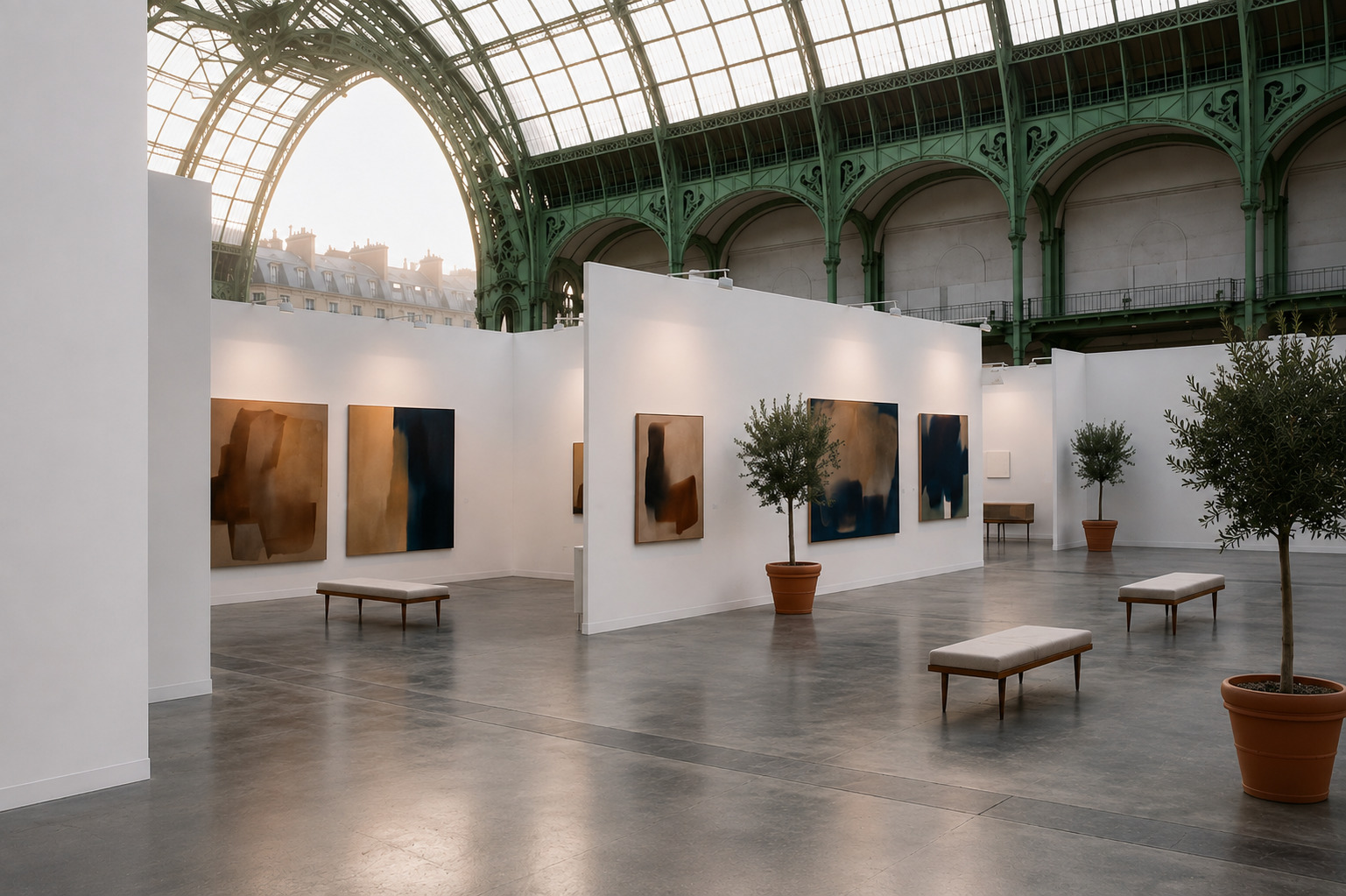
The main hall of the Grand Palais offers exceptional natural light in the early afternoon, around 3 p.m., when the glass roof allows soft light to filter down onto the exhibits. For visitors coming as a couple or with their families, Friday remains the best day: the weekend crowds haven’t started yet, gallery owners have time to chat, and several solo shows by emerging artists featured in the “Promesses” section are well worth a thorough discussion with their representatives.
Art Basel Paris in October: The World's Leading Art Houses
The Premier Fall Event
Art Basel Paris will take place at the Grand Palais from October 21 to 25, 2026, with two preview days on October 21 and 22, a public opening reception on the evening of the 22nd, and general admission from the 23rd to the 25th. This fifth edition—the first under the direction of Karim Crippa—brings together more than 200 exhibitors from over 40 countries. The selection is divided into three sectors: Galleries, featuring more than 180 modern, postwar, and contemporary galleries; Emergence, featuring 16 solo booths by emerging artists set up on the balconies of the main hall; and Premise, featuring nine galleries presenting curatorial projects with a historical focus.
The Galeries sector brings together the market’s most powerful players. Gagosian, Hauser & Wirth, David Zwirner, White Cube, Thaddaeus Ropac, and Marian Goodman engage in dialogue with Parisian galleries—Templon, Chantal Crousel, Perrotin, and Almine Rech, in a carefully choreographed display beneath the restored glass roof. Prices range from €5,000 for a work on paper to several million for a museum-quality piece, and the diversity of media—painting, sculpture, video, installation, and photography—makes every aisle worth exploring.
The opening reception and the parallel week
Art Basel Paris week transforms the capital. All the major galleries in the Marais, Saint-Germain, and the8th arrondissement hold their own opening receptions simultaneously. La Nuit Blanche has been timed to coincide with the fair’s schedule. The foundations are planning their most ambitious exhibitions. The best restaurants—Caviar Kaspia, Loulou, and Le Sergent Recruteur—are fully booked three months in advance. This concentration creates a level of foot traffic between venues that has no equal anywhere else in Europe.
Off-site art fairs: Asia Now, Drawing Now, Pareidolia
Asia Now, the voice of the Asian arts scene
Asia Now takes over the Monnaie de Paris in October, running concurrently with Art Basel Paris. This 12th edition continues to cultivate a valuable distinction: being the only Western art fair entirely dedicated to Asian art scenes and their diasporas. Galleries from Seoul, Tokyo, Taipei, Shanghai, Mumbai, and Manila come together in the historic exhibition halls on the Quai de Conti, in a curated presentation that prioritizes dialogue between mediums rather than market-driven displays.
The atmosphere at Asia Now is radically different from that of the Grand Palais. The booths are smaller, the artists are often present, and you can regularly find works priced between €2,000 and €20,000 that make for excellent entry-level pieces for a collection. It’s the go-to spot for collectors under forty who are developing their own aesthetic sensibilities.
"Drawing Now" at the Carreau du Temple
Drawing Now Paris takes place in March at the Carreau du Temple, a former covered market on Rue Eugène-Spuller in the3rd arrondissement. This fair champions a discipline often considered secondary—contemporary drawing—and puts it front and center. Seventy-one international galleries gather there for four days under the metal-and-glass canopy of the 19th-century building. Prices start at around €800 for unique works by emerging artists and rarely exceed €50,000. It’s an ideal entry point for those just starting to collect.
Pareidolia and Satellite Encounters
Paréidolie, the international contemporary drawing fair, is traditionally held in Marseille in August—a detour well worth taking for anyone looking to explore beyond Paris. Back in the capital, other events are emerging: Galleria Continua is hosting its open house weeks, Approche is dedicating its program to experimental photography, and Offscreen has been exploring practices related to photography and film for several years now.
Visitor Tips: accreditations, opening receptions, tour routes
Accreditations and Ticket Sales
For Art Basel Paris, there are two levels of access. VIP cards , distributed by galleries to their collectors and institutional partners, grant access to the two preview days, when most transactions take place. The general admission ticket, priced at €65 per day in 2025, grants access starting Friday. Art Paris offers more affordable prices, around 30 € per day, and hosts an opening reception on Tuesday evening. The best approach: reach out to a gallery from which you’ve previously purchased a work; an invitation to the opening will naturally follow.
Charting Your Path at the Grand Palais
The Grand Palais’s main hall features 13,500 m² of exhibition space. Allow at least three hours for a complete tour at a leisurely pace; ideally, five hours to strike up conversations with the gallery owners. The best way to go is to start with the balconies—which are less crowded and quieter—to explore the solo exhibitionsin the “Emergence” section, then head down to the central hall in the late afternoon. Be sure to wear comfortable shoes—the stone floor tires your legs faster than you might think—and keep the paper map you receive at the entrance: the signage is minimal.
The Etiquette of Art Openings
Parisian art openings follow a set of unspoken rules. Attire is formal but never ostentatious; conversations are held in hushed tones in front of the artworks; note-taking is permitted, but photography is allowed only with the gallery owner’s permission. A sold work is marked by a red dot affixed to the label; observing these dots often provides a better indication of the market’s health than a press release. The first pieces reserved during previews are sold within the first two hours.
The Merveil Paris Experience: Your Hub During Trade Show Week
Merveil Paris bridges the gap between private living and five-star service. Our residences are located in the capital’s most sophisticated neighborhoods—Marais, Saint-Germain, and Louvre—just a few minutes by taxi from the Grand Palais and the Monnaie de Paris. A concierge service available around the clock, a private chef upon request, and airport transfers: we take care of the details so you can focus on what matters most: art openings, meetings with gallery owners, and private foundation dinners. During Art Basel Paris week, our team can secure your credentials in advance, arrange a private tour of a foundation closed to the public, and have a purchased artwork shipped directly to its carrier. Discover our apartments near the Louvre or browse our guide to Parisian neighborhoods to choose the location closest to the art fairs.
FAQ
What is the difference between Art Paris and Art Basel Paris?
Art Paris takes place in April at the Grand Palais and champions a French and European identity; 60% of the 165 galleries are based in France. The works on display are, on average, more accessible, with a strong presence from the emerging art scene and a distinct curatorial vision. Art Basel Paris takes place in October at the same Grand Palais and brings together more than 200 international galleries, including the world’s leading galleries. The two fairs do not compete with each other but complement one another throughout the year.
When are the contemporary art fairs taking place in Paris in 2026?
In 2026, Art Paris will be held April 9–12 at the Grand Palais. Art Basel Paris opens at the same venue October 21–25, with two preview days on the 21st and 22nd. Drawing Now Paris takes place in March at the Carreau du Temple. Asia Now will be held at the Monnaie de Paris in October, running concurrently with Art Basel Paris. Several other satellite fairs— Offscreen, Approche, and Paréidolie in Marseille—round out the calendar throughout the seasons.
Do you need special accreditation to visit trade shows?
No, a general admission ticket is sufficient to visit Art Paris (about 30 € per day) and Art Basel Paris (65 € per day in 2025). Art Basel VIP cards are reserved for collectors invited by galleries and grant access to the two preview days, when most transactions take place. To obtain an invitation to the previews, the easiest way is to contact a gallery from which you have previously purchased a work or with which you have an ongoing relationship.
How much time should I set aside to visit Art Basel Paris?
Plan on at least three hours to stroll through all the aisles of the Grand Palais without rushing; ideally, five hours to have meaningful conversations with gallery owners and explore the "Emergence " and "Premise" sections. For a full experience during Art Basel week Paris, plan on three to four days: one day for the fair, one for the opening receptions at galleries in the Marais and Saint-Germain, one for private foundations, and one for studio visits organized by certain gallery owners for their collectors.

